

In the first months after migration, a person can genuinely feel as if they’ve arrived from another planet. It isn’t just the language that’s different — the pace of speech, the distance people keep in conversation, what silence means, how greetings work, how people voice disagreement, the relationship between teachers and parents, styles of raising children, and even the very idea of what counts as “polite” can all differ from everything a person has learned over a lifetime.
Back home, we knew hundreds of unwritten rules without thinking. We knew what to say at the bank, how to book a doctor’s appointment, when to offer polite refusal, who to trust, and what to read into someone’s tone. Migration suddenly takes this invisible knowledge away. A capable, experienced adult professional can feel helpless buying a bus ticket, replying to a school email, or calling an insurance company.
If this same person is also a spouse and a parent, the pressure multiplies. They don’t just need to adjust to a new society — they need to maintain their marriage, provide their child’s psychological security, earn an income, and, in front of family who may be thousands of kilometres away, pretend everything is going fine.
What exactly is culture shock?
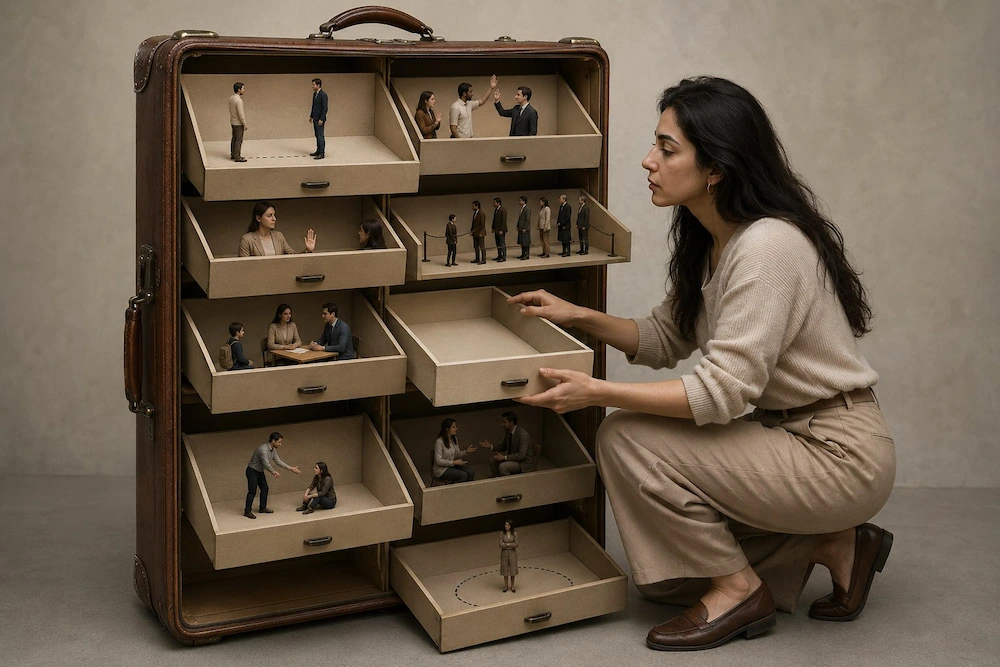
Culture shock is a cluster of emotional, cognitive, and physical reactions that arise from prolonged exposure to an unfamiliar environment. In this state, the cues that once told a person how to behave, what to expect, and how to interpret others’ behaviour no longer apply.
📊 Acculturative stress
Current scientific literature also uses the broader concept of acculturative stress. This pressure can stem from language differences, reduced social support, discrimination, economic hardship, unclear roles, differing values, and difficulty connecting with the host community. Research links this kind of stress to anxiety, depression, lower self-esteem, and difficulty with family cohesion, particularly when migration challenges are compounded by prior trauma or precarious immigration status. A scientific review published in 2024 also identified acculturative stress as a significant factor affecting the mental health of immigrant adolescents.
Source: 2024 scientific review on acculturative stress and mental health (replace with the exact study link)
Does culture shock follow distinct stages?
The classic description talks about an initial excitement stage, a period of frustration or crisis, gradual adjustment, and a relative sense of mastery. But this path isn’t identical or linear for everyone.
One person might be full of hope in the first days and then hit fatigue, homesickness, or discouragement a few weeks later. Another might never get to experience that initial excitement at all, from the very start, because of financial worry, immigration status, or separation from family. Even after months of adjustment, an unsuccessful job interview, an experience of discrimination, or bad news from Iran can reactivate the feeling of being a stranger.
Signs of culture shock in the first months
Culture shock doesn’t look the same in every person. Some become sad, others irritable. Some stop leaving the house, others exhaust themselves with constant activity. Common signs include:
- ! Mental exhaustion after a conversation in a second language
- ! Irritability, tears, or anger over small things
- ! Sleep disruption, headaches, digestive problems, or muscle tension
- ! Fear of phone calls, visiting government offices, or speaking in groups
- ! Constantly comparing the host country to the country of origin
- ! Feeling stupid or incapable while doing simple tasks
- ! Heightened sensitivity to others’ tone and behaviour
- ! Isolation and excessive dependence on a spouse or acquaintances
- ! Idealizing the past, or, conversely, fully denying any homesickness
- ! Reduced focus and difficulty making decisions
- ! A feeling of “I’m not myself anymore”
When a couple’s old conflicts resurface in a new country
Migration usually doesn’t resolve a couple’s unresolved problems — it puts more pressure on the same vulnerable points. A couple who disagreed before migration about money, division of responsibilities, extended family, parenting, or intimacy may face a more intense version of those same conflicts in a new country.
In the first months, roles can also shift. One partner might learn the language faster, find work sooner, or build a social network first. The other may lose their professional standing, financial independence, or self-confidence. As a result, a seemingly simple disagreement about groceries, driving, or replying to an email may sit on top of a deeper layer about power, dependence, status, and fear of not being enough.
📊 Research evidence
Research on immigrant couples shows that acculturative stress can be associated with increased marital distress and family conflict. At the same time, the two partners adjusting at different speeds doesn’t necessarily mean a fundamental incompatibility or the end of the relationship — but if it isn’t discussed, it can create emotional distance.
Source: research on acculturation in immigrant couples (replace with the exact study link)
What can couples do in the first months?
1
Correctly identify the shared enemy. Sometimes the real problem isn’t your spouse. It’s economic pressure, lack of sleep, loss of status, loneliness, and an uncertain future. Instead of “you never help with anything,” it helps to say: “We’re both under a lot of pressure — let’s figure out what we can lighten this week.”
2
Postpone major decisions at the height of crisis. The first months usually aren’t the right time for rushed decisions about separation, major purchases, having children, or completely changing your immigration path — unless there’s an urgent issue like violence or a lack of safety.
3
Hold a weekly family check-in. Thirty minutes a week, no phones, covering three questions: What was hard this week? What went well? What does each person need help with next week?
4
Divide tasks based on current capacity, not old traditional roles. Whoever currently has more language ability or system knowledge may end up handling certain tasks, but this shouldn’t turn into humiliation or a fixed pattern of dependence. It’s best to revisit the division of labour regularly.
5
Don’t let the relationship shrink into an immigration project. If every conversation is only about rent, insurance, school, and work, intimacy gradually fades. Even a short walk, tea without talking about problems, or watching something together can protect the relationship.
The school-age child: often faster to learn the language, but not necessarily less affected
Children may appear to adjust to a new environment faster than their parents, but that speed shouldn’t be mistaken for an absence of psychological strain. An immigrant child may have simultaneously lost friends, school, neighbourhood, extended family, their dominant language, and their sense of competence.
They walk into a classroom whose social rules they don’t know. They may not get their classmates’ jokes, feel embarrassed about how their name is pronounced, end up alone at recess, or be unable to show what they know in English. A temporary dip in academic performance in this situation isn’t necessarily a sign of lower intelligence or laziness.
📊 2025 study
A study published in 2025 finds that acculturative stress is linked to self-esteem, depressive symptoms, and family dynamics in first-generation immigrant children. A sense of belonging at school and family cohesion can play a protective role in their adjustment.
Source: study on first-generation immigrant children, 2025 (replace with the exact study link)
How can parents support their child?
- Don’t ask only about grades and homework every day — ask: “How was recess? Who did you sit with? What didn’t make sense to you today?”
- Don’t dismiss the child’s feelings. Phrases like “you’re a kid, you’ll get used to it fast” can deepen their loneliness.
- Maintain safe, balanced contact with friends and relatives in the home country.
- Don’t treat Persian as an obstacle to learning English. Keeping the family language is part of a child’s identity and emotional connection.
- Stay in touch with the teacher, school counsellor, ELL staff, and, where available, the Settlement Worker in Schools.
- Don’t turn the child into the family’s permanent translator. If a child ends up responsible for parents’ medical, financial, or administrative calls, they’re taking on roles beyond their age.
- Create small, regular opportunities for friendship — library programs, sports, an art class, or a playdate with a classmate.
- Take behavioural changes seriously: repeated refusal to go to school, physical pain with no clear cause, a sharp academic decline, nightmares, aggression, withdrawal, or statements about being worthless all warrant a closer look.
Eight practical strategies for a healthier adjustment
1
Start by making life small and predictable
You don’t need to have your whole life figured out in the first few weeks. Pick three real priorities — say, housing, your child’s school, and access to healthcare. An endless to-do list keeps the nervous system on high alert.
2
Build a “survival map”
Record the address of the school, clinic, pharmacy, grocery store, library, transit stop, and essential phone numbers in one shared family file. Knowing exactly where to go for each need increases your sense of control.
3
Use cultural observation instead of cultural judgment
Instead of immediately concluding “people here are cold” or “no one is warm,” it helps to ask: “In this culture, how — and over what timeframe — is closeness typically shown?” Changing the question makes the difference easier to understand.
4
Create short but daily contact with the language
Language learning doesn’t happen only in a classroom. A short conversation at the grocery store, asking a question at the library, or purposefully listening to a podcast can all be effective. The initial goal is being understood, not speaking without an accent or a mistake.
Eligible individuals, including many permanent residents and protected persons, can access free LINC (Language Instruction for Newcomers to Canada) classes.
Official information on Canadian language classes: canada.ca
5
Build two types of social network
Connecting with fellow Persian speakers can create a sense of safety, mutual understanding, and immediate support. But staying entirely within that community can slow down getting to know the new society. A healthy network can include both people who share your culture and gradual contact with the broader community.
6
Keep family rituals alive
Familiar food, music, a weekly call home, movie night, or cultural celebrations send the brain a message of continuity: “not everything has been lost.” Healthy adjustment doesn’t mean erasing your former identity. The goal is to create a space where your former identity and your new life can exist side by side.
7
Don’t leave the body out of the adjustment process
Regular sleep, daylight, walking, predictable meals, and cutting back on excessive caffeine all directly affect psychological resilience. Someone who’s been sleep-deprived for weeks experiences cultural differences as more threatening, and family conflicts as more intense.
8
Use settlement services and your local community
Asking for help doesn’t mean you’re incapable. Settlement organizations can offer guidance on language, employment, credential assessment, family services, and getting to know the community. The Government of Canada provides a way to search for organizations offering free services to newcomers.
Search for free newcomer services: ircc.canada.ca
In British Columbia, a list of services related to permanent residents, refugees, and some temporary residents is available through the WelcomeBC website.
Official newcomer resources in British Columbia: welcomebc.ca
When is culture shock no longer just a passing phase?
If distress is gradually easing and a person can still manage their daily responsibilities despite the difficulty, they’re likely on a normal adjustment path. But in the following situations, it’s better to get help from a doctor, counsellor, or psychotherapist:
- ! Anxiety, insomnia, or low mood has continued for several weeks
- ! The person can’t manage work, childcare, or daily tasks
- ! Panic attacks, severe hopelessness, or problematic substance use have developed
- ! Conflict between partners has escalated to contempt, threats, control, or violence
- ! A child consistently refuses to go to school, or shows a significant behavioural change
- ! There are thoughts of harming oneself or others
In an immediate crisis or with thoughts of suicide in Canada, call 911 or the 988 crisis line.
Migration means learning the world, a second time

At first, culture shock can convince a person that they no longer belong anywhere — that they can’t quite return to their former life, and haven’t yet put down roots in the new one. But this space between two worlds isn’t necessarily permanent.
Adjustment doesn’t happen when an immigrant sets aside every part of who they were and tries to become like everyone else. Healthy adjustment means being able to learn the rules of a new environment without denying your language, memories, values, and former identity. Gradually, a person figures out how to ask questions at their child’s school, how to talk to their spouse about new pressures, where to ask for help, and which parts of the new culture to weave into their own life.
Sometimes an immigrant family doesn’t just need information to get through this period — they need a space where they can voice their fear, anger, homesickness, sense of failure, and conflicts without shame.
A counsellor who speaks the same language and understands the immigration experience can help family members recognize which problems stem from the pressure of cultural transition, which conflicts come from the past, and what kind of support each one calls for. The goal of counselling isn’t to erase homesickness — it’s to help a family find a shared way of building a new home, before the pressure of migration pulls its members apart.
A few common questions about culture shock
How long does culture shock last?
How is culture shock different from depression?
Do children who learn the language faster carry less of a burden?
When should someone see a counsellor about culture shock?
Do you need counselling or psychotherapy?
To book a session with Dr. Taraneh Moazeni, get in touch through the website.