
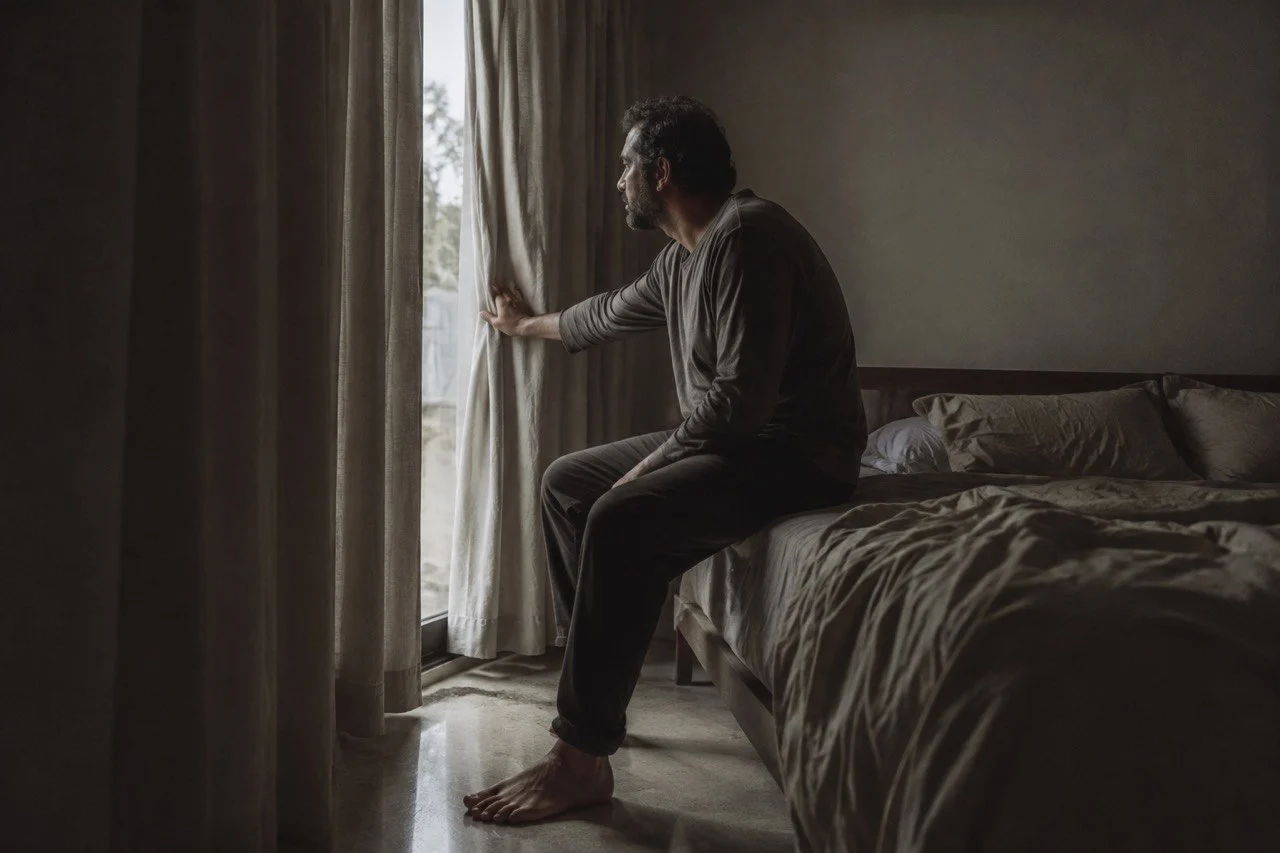
Depression is more than ordinary sadness. It can quietly change how a person thinks, feels, and moves through daily life, sometimes without a single dramatic event marking its beginning. A person may still go to work, care for their family, and appear to be managing, while inside almost nothing feels the way it used to.
Depression treatment in Farsi and English provides an evidence-based space to understand this experience clearly, without judgment, and to build a realistic path toward feeling better.
1

Depression is a clinical condition that affects mood, thinking, energy, sleep, appetite, and the ability to feel pleasure. It is not simply a passing low mood. It can persist for weeks or months and significantly affect a person’s functioning, relationships, and sense of self.
Depression is not a sign of weakness or a character flaw. It is a recognized psychological and often biological condition that responds to appropriate treatment.
2
Sadness is a normal human emotion that arises in response to loss, disappointment, or difficulty. It usually has an identifiable cause, fluctuates over time, and gradually eases as circumstances change or as the person adapts.
Clinical depression is different. It may not have a single clear trigger. It tends to be more persistent, touches nearly every part of daily functioning, and does not reliably lift on its own. A person may struggle to explain why they feel this way, which can add confusion and self-blame to an already difficult experience.
Depression is not simply feeling sad for a long time. It changes the entire lens through which a person experiences themselves, other people, and the future.
3

Depression does not always look like visible sadness or crying. It may appear as irritability, numbness, difficulty concentrating, physical fatigue, changes in sleep or appetite, or a loss of interest in activities that were once enjoyable. Some people describe feeling emotionally flat rather than sad, as though a layer of glass separates them from their own life.
Because these signs can be mistaken for stress, laziness, or simply a difficult phase, depression is sometimes not recognized until it has been present for a long time.
4
Depression does not present the same way in everyone. Recognizing its specific form can help guide more accurate treatment.
A distinct episode involving persistent low mood or loss of interest, along with other symptoms, lasting at least two weeks and significantly affecting daily functioning.
A chronic, lower-intensity form of depressed mood that continues for two years or more, often becoming so familiar that the person no longer recognizes it as a treatable condition.
A pattern of depressive episodes that recur during a particular season, most commonly during the darker months of the year, and improve as the season changes.
Depression that develops during or after pregnancy, going beyond the more common and shorter-lived experience of the “baby blues.”
A depressive episode occurring within bipolar disorder, which also involves periods of elevated mood or energy and requires a distinct treatment approach.
Depression concealed behind continued achievement and outward competence, where the person expends enormous energy to maintain appearances while suffering internally.
5

Depression rarely has a single cause. Biological factors, genetics, chronic stress, significant loss, relationship difficulties, immigration and cultural adjustment, and long-standing psychological patterns can all play a role, often in combination. The absence of one obvious triggering event does not make the depression any less real.
6

Depression often creates a self-reinforcing cycle. Low mood leads to withdrawal from activities and relationships. This withdrawal reduces opportunities for pleasure, accomplishment, and connection, which in turn deepens the low mood.
Behavioural activation is an evidence-based approach that works by gently and deliberately reversing this cycle. Rather than waiting to feel motivated before acting, the person is supported in taking small, structured steps back into meaningful activity, even when motivation has not yet returned. Mood improvement often follows renewed engagement rather than preceding it.
7
Cognitive therapy examines the relationship between thoughts, emotions, and behaviour. Depression is often accompanied by persistent negative thinking patterns, such as harsh self-criticism, hopelessness about the future, or a tendency to interpret neutral events negatively.
Therapy does not involve simply replacing negative thoughts with forced positivity. It helps the person identify these patterns, examine the evidence for and against them, and develop more balanced and accurate ways of understanding themselves and their circumstances.
8
For some people, medication can be a helpful part of depression treatment, particularly for moderate to severe symptoms. Decisions about medication should be made together with a physician or other qualified prescriber, based on a careful assessment of symptoms, history, and individual circumstances.
Medication and psychotherapy are not mutually exclusive. For many people, a combination of both approaches offers the most effective path toward recovery.
9
For Farsi speakers, receiving treatment in one’s first language can make it easier to express the true depth of an emotional experience. Concepts such as shame, family duty, and a sense of failure often carry cultural weight that can be difficult to translate accurately into a second language.
A culturally informed, Farsi-speaking therapist can help create a space where these experiences are understood in their full context, without requiring constant explanation or translation.
10
You do not need to wait until symptoms become severe before reaching out. If low mood, loss of interest, or fatigue have lasted for more than two weeks and are affecting your daily life, relationships, or work, it is worth speaking with a mental health professional.
If you or someone you know is thinking about suicide or self-harm, you can call or text 988 anywhere in Canada, 24 hours a day. If there is an immediate danger, call 911 or go to the nearest emergency department.
Routine online counselling is not a substitute for emergency crisis services.
11
