

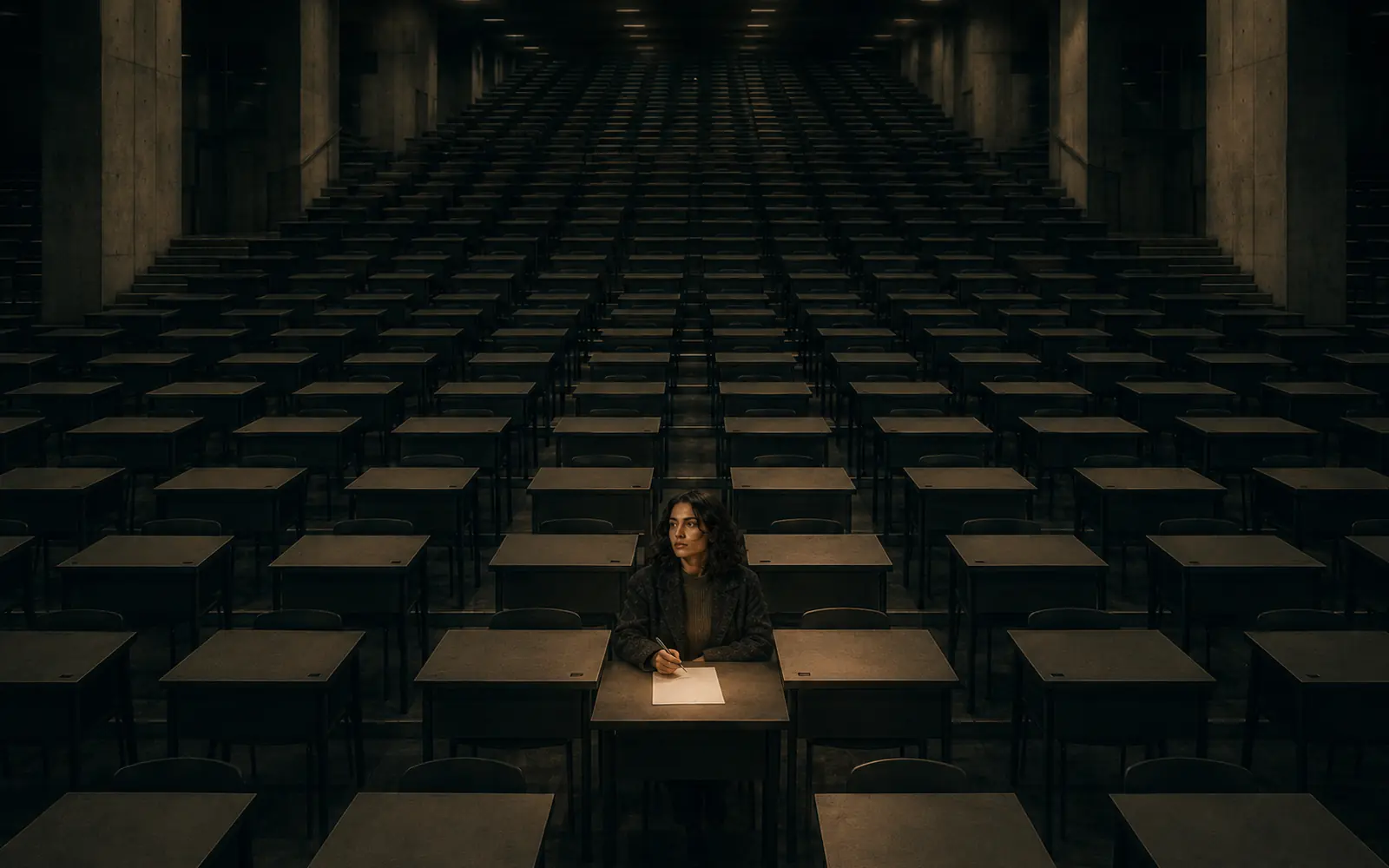
It’s eleven at night, and the university library is still lit. At a desk, amid a pile of notes, sits a student who, a few months ago in Tehran, studied with confidence — or was the top of the class. Now she has to keep up with a new language, steep rent, a work shift, and the unwritten rules of a university, all at once, and still be her best. From the outside, everything looks like success. From the inside, there’s an exhaustion no one sees. Science has a name for part of that exhaustion: acculturative stress.
For many Iranian students, Vancouver is the image of a new life beginning: a respected university, more professional opportunities, independence, and hope for a more secure future. But behind that image runs a more complicated reality. A student who was capable and successful in Iran may suddenly find herself grappling with language, housing, tuition, building a social network, and the unwritten rules of the university, all while still needing to perform well, work, and make decisions about her immigration future. It’s exactly this gap between the outward appearance of success and the difficult inner experience that so often hides psychological burnout.
💡 A necessary reframe
A mental health struggle in this situation is not a sign of weakness or ingratitude. In most cases, it’s a completely understandable response to a heavy volume of change, ambiguity, and pressure. Recognizing this experience is the first step toward managing it in a healthier way.
Why can studying abroad be psychologically difficult?
Research shows that, on top of the usual pressures of university, international students face factors such as cultural adjustment, distance from their support network, language difficulties, discrimination, financial worry, and uncertainty about the future. A review of research on international student wellbeing in Canada also finds that mental health is one of the most frequently reported concerns in this population.
In psychology, part of this experience is explained by the concept of acculturative stress: the pressure that comes from living and functioning in a new culture, and the effort to build balance between a former identity and a new life. British Columbia’s international student health guidance likewise emphasizes that homesickness and acculturative pressure can turn the experience of studying into a period marked by loneliness and psychological difficulty. This weighs heavier still when several stressors are present at the same time.
The main challenges Iranian students face in Vancouver

1
Loneliness, even in a crowd
Loneliness isn’t just the absence of people around you. A student may have plenty of classmates, coworkers, and acquaintances, yet still feel that no one truly understands their experience. New relationships usually take time to move from surface familiarity to a felt sense of trust and safety.
2
Academic pressure and perfectionism
Many Iranian students arrive in Canada with a strong academic record, and success has been part of their identity for years. Because of this, a low grade or critical feedback can register not as a normal event but as a sign of “not being enough.” Maladaptive perfectionism ties a person’s worth to their performance and treats any mistake as a threat.
3
Financial pressure and Vancouver’s high cost of living
International students typically face limits on their permitted work hours and have constrained financial resources, while rent and tuition in Vancouver rank among the highest in Canada. Financial pressure isn’t just an economic issue — it can also affect a sense of security, focus, sleep, and decision-making.
4
Worry about the future and immigration status
For many students, graduation marks the end of one clear stage and the start of an ambiguous one. Finding work, the necessary permits, the path to residency, and the possibility of returning home all occupy the mind. Anxiety in this situation isn’t always the product of “irrational thoughts” — some of it is a genuine response to real ambiguity.
5
Cultural distance and living between two worlds
An Iranian student may feel caught between family values and the expectations of a new environment — feeling “too Iranian” in Canada, and, in contact with Iran, feeling “no longer quite the same” as before. Healthy adjustment doesn’t mean abandoning one’s culture of origin. A person can consciously hold parts of both cultures within their identity — a gradual process that may come with confusion or grief.
6
Difficulty seeking help, and social stigma
Some assume that seeing a counsellor is only for severe crises. Others worry a therapist won’t understand their cultural background or immigration experience. Language matters too — even someone who speaks fluent English may find it harder to express feelings precisely in a second language.
📊 ~17%
According to Statistics Canada, in the first quarter of 2024, roughly 17% of Canadians aged 15–24 reported often feeling lonely. The same data show that having a reliable person in one’s life is linked to a greater sense of belonging and better mental health. For an immigrant student, losing everyday access to family and old friends can deepen this vulnerability.
Canadian research on post-secondary students has also found that barriers such as long wait times, cost, concerns about confidentiality, social stigma, and services that don’t fit cultural needs can delay help-seeking. Counselling that is culturally responsive — and available in Persian, when that’s a person’s preference — can increase a sense of safety and mutual understanding.
Warning signs not to ignore
Psychological strain doesn’t always show up with one clear marker. It can appear as reduced focus, procrastination, irritability, or pulling away from others. Signs worth paying attention to include:
- • Sleep disruption, persistent fatigue, or a noticeable shift in energy
- • Reduced focus, motivation, or academic performance
- • Withdrawing from friends and everyday activities
- • Constant worry and difficulty calming the mind
- • Recurring physical symptoms — headaches or digestive issues during stressful periods
- • Feelings of hopelessness, worthlessness, or guilt
- • Panic attacks or a sense of losing control
- • Noticeable difficulty keeping up with usual responsibilities
Having one of these signs doesn’t necessarily mean a diagnosable condition. But if symptoms are intense, have lasted several weeks, or are affecting your studies, work, or relationships, a professional assessment can be genuinely helpful.
Evidence-based ways to strengthen your mental health
1
Name what you’re experiencing
Instead of “I’ve become weak,” define the problem more precisely. Are you dealing with loneliness, financial pressure, perfectionism, homesickness, or worry about the future? A simple exercise: write down, “What am I feeling right now? What activated this feeling? What do I need in this moment?” These three questions help distinguish emotion, trigger, and need.
2
Build a minimal, sustainable routine
During high-pressure periods, ideal schedules usually don’t hold. Set a few fixed anchors: a reasonably regular sleep time, regular meals, physical movement, and short breaks. For studying, breaking work into small, specific units is usually more effective than broad goals like “I need to study a lot today.”
3
Build your support network deliberately
Regularly attending a student group, volunteering, or joining a professional association creates repeated contact — and that repeated contact is what builds trust and belonging. It’s best if the network isn’t limited only to fellow Persian speakers or only to the host culture. Connection with the Iranian community offers a sense of being culturally understood, while connection with more diverse groups builds adaptability to the new environment.
4
Confront perfectionism behaviorally
In a cognitive-behavioural approach, perfectionistic predictions need to be tested. For example, send a low-stakes email after just two rounds of review, and compare the actual outcome with the feared prediction. “Good enough” doesn’t mean irresponsible — it means matching your effort to the task’s actual importance and accepting that learning without any mistakes isn’t possible.
5
Contain worry to a set time
If your mind is preoccupied with the future all day, set aside a 15–20 minute “worry window.” Write worries down and sort each into one of two categories: issues with a clear next action, or things that currently have no answer. For the first, identify the smallest next step. For the second, redirecting attention to the present moment is more useful than continued mental analysis.
6
Seek help before you reach burnout
Counselling isn’t only for when someone can no longer function. Early intervention can help identify anxiety patterns, address perfectionism, manage migration grief, and strengthen coping strategies. If expressing emotions in English feels difficult, or cultural context plays a significant role, working with a Persian-speaking therapist familiar with the immigration experience is a reasonable choice.
How can psychotherapy help?
Effective psychotherapy doesn’t dismiss the real pressures of life. Therapy is a space for understanding the relationship between external circumstances, emotions, thoughts, and behaviour, and it can focus on calming anxiety, reducing avoidance, building self-compassion, problem-solving, and rebuilding a sense of identity and belonging.
Approaches such as Cognitive Behavioural Therapy (CBT), Acceptance and Commitment Therapy (ACT), mindfulness-based interventions, and interpersonal therapy have solid research support for many common student concerns. Still, more important than the name of the approach is accurate assessment, a safe therapeutic relationship, and a genuine fit between the treatment and the client’s culture, language, and goals.
📊 Your confidentiality, to Canadian standards
All sessions are fully confidential — under British Columbia’s Personal Information Protection Act (PIPA) for BC, and under Canada’s federal Personal Information Protection and Electronic Documents Act (PIPEDA) for online sessions across the country. Sessions are held online for students throughout British Columbia and Canada.
In closing: adjustment is a path, not a test
An Iranian student in Vancouver may, at the very same time, take pride in their accomplishments and struggle with loneliness, worry, and exhaustion. These two experiences aren’t a contradiction. Immigration can open doors, and still carry a real psychological cost.
Frequently Asked Questions
Is feeling lonely and overwhelmed normal during student life in Vancouver?
When should I see a counsellor about my mental health?
Can I have sessions in Persian?
Which therapy approaches are most helpful for students?
You don’t have to walk this path alone
If the pressure of these days feels like more than you can carry, a first session is a chance to start gently and see how I can support you.